
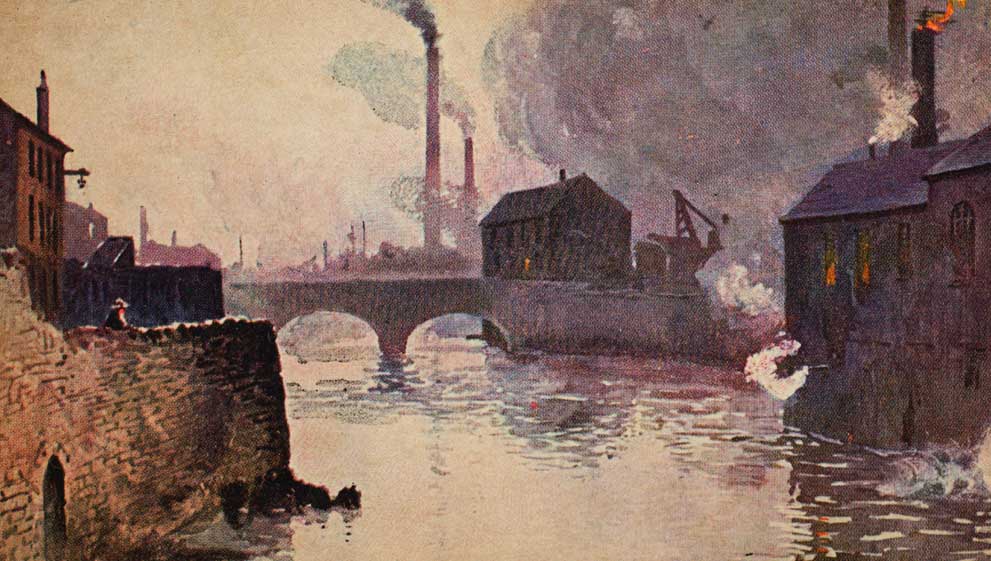
The invention of stainless steel stands as one of the most significant advances in twentieth-century metallurgy, and its origins lie firmly in the industrial heart of Sheffield. Long celebrated for its steelmaking expertise, the city provided the unique combination of craftsmanship, experimentation, and industrial ambition that made such a breakthrough possible. In 1913, the metallurgist Harry Brearley, working at the Brown-Firth Research Laboratories, identified an alloy that resisted rust and corrosion, a discovery that would alter the course of engineering and manufacturing across the world.
By the early 1910s, Sheffield’s steel industry had begun to combine traditional practical knowledge with emerging scientific methods. The Brown-Firth Laboratories, established to investigate the properties of alloys. In 1912, Brearley was asked to investigate the problem of barrel erosion in small-arms manufacture, an issue of material wear rather than corrosion. Drawing on both laboratory precision and Sheffield’s workshop experience, he conducted systematic experiments, producing a series of small crucible melts in which the carbon and chromium contents were carefully varied.
On 13 August 1913, Brearley poured an alloy containing approximately 12.8 percent chromium and 0.24 percent carbon. Polished samples of this metal were unusually resistant to attack by acids, refusing to etch or rust under test. In his later autobiography, Knotted String: Autobiography of a Steel-maker (1941), Brearley recalled how these results immediately distinguished the material from ordinary steels. The sample, recorded as Cast No. 1008, is recognised today as the first known instance of what became martensitic stainless steel. Brearley himself later observed that those in authority “saw nothing of commercial value and still less of scientific interest in it,” yet the workmen who handled the test pieces recognised its potential straight away.
Seeking practical applications, Brearley approached Sheffield’s cutlery makers. At R. F. Mosley & Co in Portland Works, cutlery manager Ernest Stuart tested the new metal with vinegar and lemon juice, both known to tarnish ordinary steel. When the bright surface remained unchanged, Stuart suggested that the alloy should be called “stainless steel,” a name that quickly replaced Brearley’s own term, “rustless steel.” This act of renaming reflected not only the city’s inventiveness but also its instinct for commercial presentation. Sheffield’s manufacturers immediately recognised that a corrosion-resistant cutlery steel could secure a lasting advantage in both domestic and export markets.
Commercial progress, however, was gradual. Patent disputes and questions of ownership complicated the early years, and Brearley eventually left Brown-Firth in 1915 to join Brown Bayley Steels as a director. Despite these difficulties, small-scale production of stainless cutlery began, and the new material steadily gained reputation. In 1920, Brearley’s contribution was formally acknowledged when the Iron & Steel Institute awarded him the Bessemer Gold Medal, its highest professional distinction. Reflecting on this honour, Brearley described it as “the only distinction I had ever audibly coveted,” a modest remark that revealed his preference for practical achievement over personal acclaim.
Meanwhile, research in Sheffield continued. At the same laboratory where Brearley had worked, his successor William Herbert Hatfield developed the 18/8 chromium-nickel alloy in 1924, a composition that remains fundamental to modern stainless steels. Together, their work ensured that Sheffield retained its global reputation as the birthplace of stainless technology. The collaboration of metallurgists, craftsmen, and industrialists within the city demonstrated how scientific insight and local skill could together reshape materials science.
A century after that first successful melt, stainless steel has become a material synonymous with modern life, used in architecture, medicine, engineering, and household goods.
Over 100 years later and Harry Brearley's invention can still be seen in all our products from Stainless Steel Hand Wash Basins to Stainless Steel Vanity Tops. Stainless Steel - a discovery that has truly stood the test of time, and corrosion.
For more historical stainless steel stories on our website have a look at these past articles:
What is this strange rustless steel? And why does it make such good beer?
No Stropping, No Honing… not with Stainless Steel!
Maybe Stainless Steel wasn’t invented in Sheffield after all?
Sources:
Harry Brearley, Knotted String: Autobiography of a Steel-maker (1941);
British Stainless Steel Association – The Discovery of Stainless Steel;
Portland Works, Sheffield;
Iron & Steel Institute, Bessemer Medal Records (1920);
W. H. Hatfield, The Development of Stainless Steels (1924);
World Stainless Association – History of Stainless Steels.