
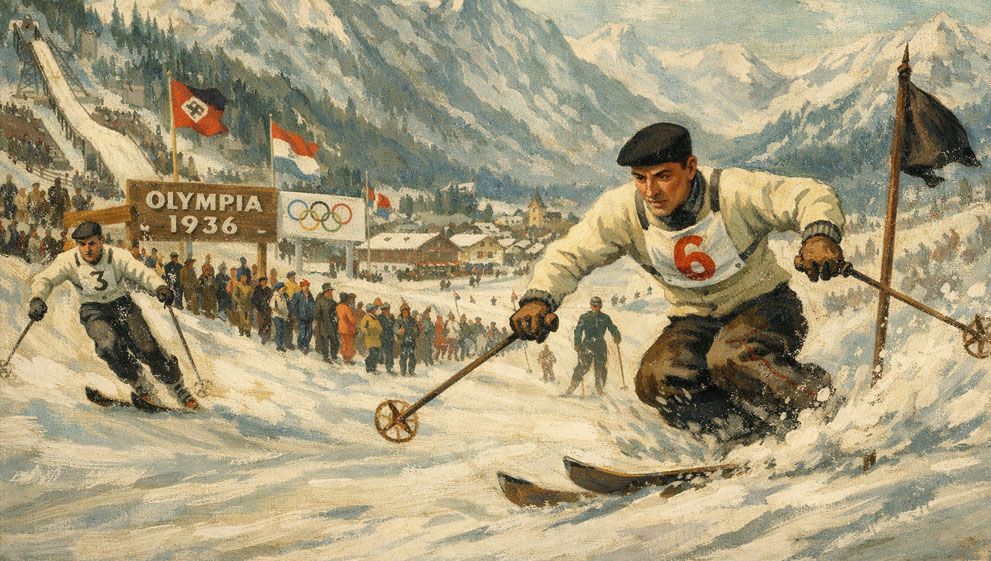
From the earliest days of skiing, controlling speed and direction on hard snow has been a challenge. For centuries, skis were made entirely from wood and relied on length and technique rather than grip. While this worked for travel and hunting, it became a limitation as skiing developed into a sport and skiers began tackling steeper and icier terrain. By the late 19th and early 20th centuries, manufacturers started reinforcing skis with metal strips along the edges. These early edges were usually made from plain carbon steel. They improved grip, but they came with a drawback: constant exposure to wet snow caused rust, which quickly dulled the edge and reduced performance. As skiing grew more competitive, this became a serious problem. At the same time, advances in metallurgy were beginning to change what was possible. During the early decades of the 20th century, European steelmakers developed chromium-bearing and alloy steels that resisted corrosion far better than traditional carbon steels. By the late 1920s and early 1930s, ski manufacturers in Alpine regions such as Austria, Germany and Switzerland were increasingly using these corrosion-resistant steels for ski edges.
Contemporary sources rarely use the modern term “stainless steel”. Instead, period catalogues and manuals refer to “steel edges” or “rust-resisting metal edges”, without specifying exact compositions. What is clear is that manufacturers were deliberately moving away from steels that rusted easily, in favour of alloys that stayed sharper for longer and required less maintenance. These properties closely align with those that define stainless steel today. This shift was well established by 1936, when Alpine skiing made its Olympic debut at the Winter Games in Garmisch-Partenkirchen. By this point, metal-edged skis were standard equipment for elite racers. While there is no surviving documentation that allows the precise metallurgical makeup of individual Olympic skis to be proven, it is highly likely that competitors were using corrosion-resistant alloy steel edges. Plain carbon steel edges would have been a disadvantage on hard-packed and icy courses. As skiing continued to develop through the mid-20th century, materials and manufacturing methods became more refined. Ski construction evolved to include laminated cores, synthetic bases and, eventually, precisely engineered metal components. Stainless steel emerged as the ideal material for ski edges, offering the combination of hardness, toughness and corrosion resistance needed for consistent performance.
Today, hardened stainless steel edges are a defining feature of modern alpine skis. They allow skiers to carve clean turns, maintain control at speed and rely on their equipment in a wide range of snow conditions. While stainless steel rarely draws attention in its own right, its contribution to the evolution of skiing has been fundamental. From early alloy steel experiments to the precision edges used today, it represents a quiet but enduring example of how material innovation has shaped sport.
DSM Stainless Products works with stainless steels for similar reasons: reliability, hardness, corrosion resistance - all really important in products like our stainless steel laboratory sinks or stainless steel wash troughs. Like the skis, stainless steel really is a material that edges ahead.
For more sports stainless steel stories on our website have a look at these past articles:
The Stainless Steel Italian Icon That Won’t Rust
What links hoop skirts, umbrellas and badminton rackets?
From bone to a Stainless Steel triple salchow
Image: HMS BELFAST at anchor in Sydney harbour, August 1945. Based on an image created and released by the Imperial War Museum - link