
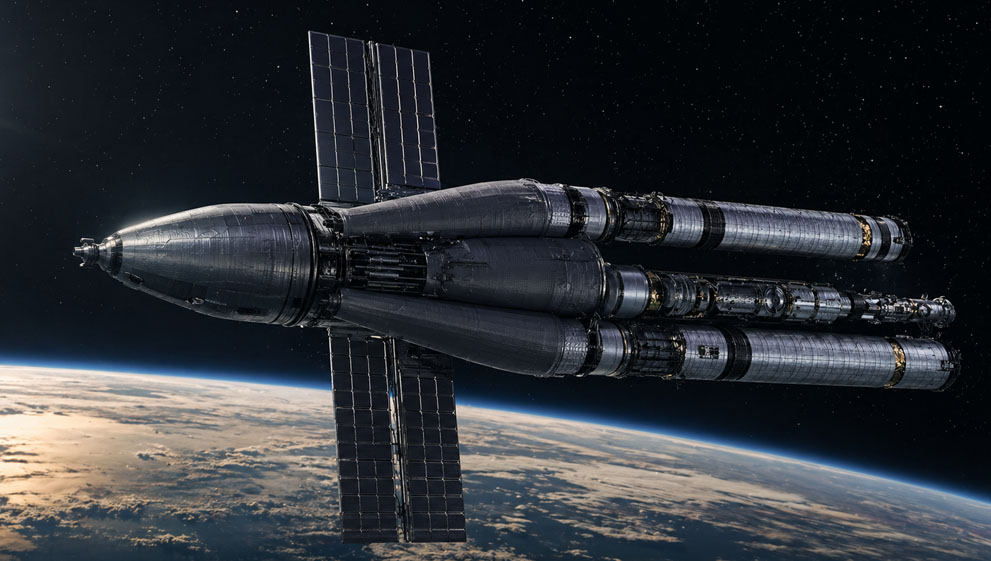
In Andy Weir’s Project Hail Mary, the spacecraft at the centre of the story is described as a relatively compact, highly efficient vessel, measuring around 47 metres in length and built from a series of cylindrical modules roughly 4 metres in diameter. It’s a design that feels surprisingly grounded, closer in scale to a modern rocket stage than the vast, sprawling ships often seen in science fiction. But as with many film adaptations, early visuals of the Hail Mary on screen suggest something far larger, with estimates putting the cinematic version closer to 167 metres in length. That difference in scale opens up an interesting question: how much stainless steel would be needed if a spacecraft like this were built in the real world?
Taking the original 47 metre design as a starting point, the ship can be visualised as a long, narrow cylinder with interconnected modules: a nosecone, crew section, laboratory and fuel storage arranged along a central spine. At roughly 4 metres in diameter, the external surface area comes in at just under 600 square metres. Once internal structure, reinforcement and bulkheads are taken into account, a stainless steel build could reasonably require somewhere in the region of 40 to 80 tonnes of material. At current industrial prices, that would put the raw steel cost comfortably into the low hundreds of thousands, a relatively small figure when set against the wider cost of a space mission.
Scale that same design up to a 167 metre film interpretation (roughly), however, and things change dramatically. Surface area increases significantly, internal structure becomes more complex, and the total material requirement could easily climb into the range of 150 to 300 tonnes of stainless steel, depending on thickness and configuration. Even then, the raw material cost would likely remain in the low millions.
This idea is not as far removed from reality as it might seem. Elon Musk made the unconventional decision to construct SpaceX Starship from stainless steel rather than carbon composites, citing its strength at cryogenic temperatures, resistance to extreme heat, and ease of manufacturing. Stainless steel becomes tougher in the cold vacuum of space, handles thermal stress exceptionally well, and allows for faster, more cost-effective construction, qualities that would be essential for a mission on the scale of the Hail Mary.
For a spacecraft designed to operate under both sustained thrust and rotational forces to simulate gravity, structural integrity would be critical. Stainless steel offers a predictable, durable solution that can withstand repeated stress without the complexity of more advanced materials. It is also easier to repair and modify, an important consideration for any long-duration or experimental mission.
Of course, there are compromises. Stainless steel is heavier than many aerospace-grade composites, and that added mass would place greater demands on propulsion systems, particularly during launch. It also provides limited protection against cosmic radiation, meaning additional shielding would be required for crew safety. But when balancing cost, manufacturability and performance, it becomes clear why it is being reconsidered as a serious material for next-generation spacecraft.
What makes this comparison particularly compelling is how closely science fiction and real engineering are beginning to align. Whether at 47 metres or 167 metres, the Hail Mary represents a design philosophy that is no longer purely speculative. With stainless steel already proving its worth in modern spaceflight, the idea of building interplanetary vehicles from such a familiar material feels increasingly within reach.
And if your own projects are staying a little closer to Earth, DSM’s range of bespoke stainless steel products is a solid place to start, because when it comes to performance, we're a companyl that really knows how to rise above the competition… a truly stellar performer.
For more stainless steel space stories on our website have a look at these past articles:
SpaceX Successfully Launches and Lands Starship - a Milestone in Elon Musk's Quest for Mars