
In the years following the discovery of stainless steel in 1913, Sheffield’s metallurgists were not content to leave the material confined to the laboratory or the cutlery workshop. Among them was Dr W H Hatfield, a leading figure in advancing stainless alloys for practical use.
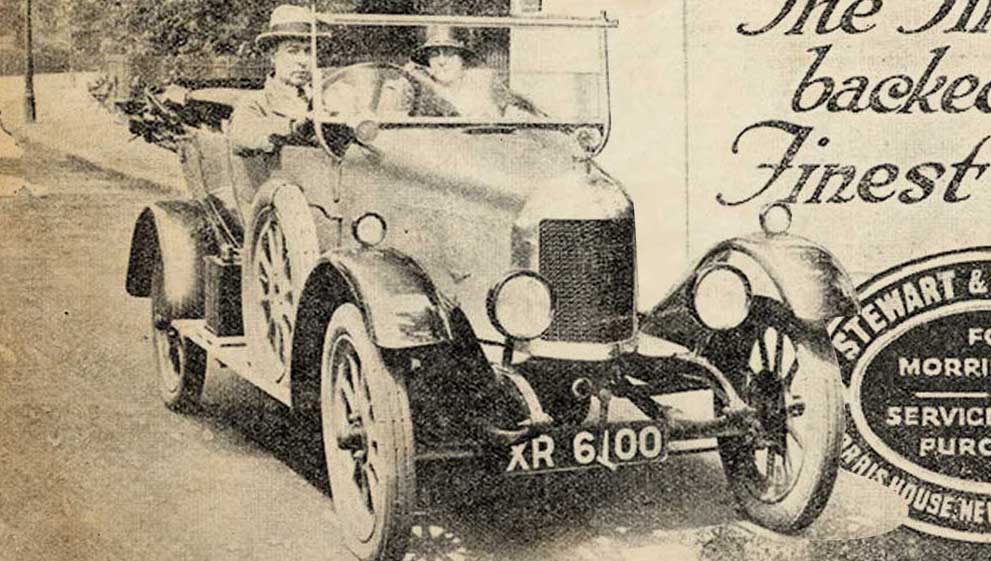
Working at Firth Brown Steels, Hatfield helped refine what would become the now-familiar 18/8 stainless steel. But beyond the furnace, he also explored how the material might perform in everyday engineering. One of his most intriguing experiments involved fitting stainless steel components to his own Morris Cowley Bullnose.
Rather than constructing a full body, Hatfield applied stainless steel to the radiator surround and trim - areas typically vulnerable to corrosion, heat, and constant exposure to the elements. At a time when rust and tarnishing were accepted as unavoidable, this was a quietly radical move. The stainless components offered durability, resistance to weathering, and a lasting polished finish without the need for continual maintenance.
The Morris Cowley name was used across a range of models produced between 1915 and 1958, but its origins lie in one of the most interesting early examples of British automotive engineering.
Introduced to the press in April 1915, the original Cowley, often referred to as the Continental Cowley, was a larger, more practical development of the first Morris Oxford. It retained the distinctive “bullnose” radiator but featured a bigger 1495cc engine (compared to the Oxford’s 1018cc), along with a longer and wider chassis capable of carrying four passengers.
In an effort to keep costs competitive, many of the car’s components were sourced from the United States. The engine was supplied by the Continental Motor Manufacturing Company of Detroit, while the clutch and three-speed gearbox came from Detroit Gear & Machine Co. Axles and steering gear were also imported, although supply was later disrupted by the outbreak of the First World War.
The Cowley’s design reflected these transatlantic influences. Its centrally positioned handbrake and gear lever improved accessibility, while the rear axle featured a helically cut drive, an innovation not previously seen in British mass-produced cars. Suspension was provided by semi-elliptic leaf springs at the front and three-quarter elliptics at the rear.
Notably, the Cowley was also ahead of its time in adopting electric lighting as standard. A set of six-volt Lucas lamps, powered by a belt-driven dynamo, was fitted though this added significant cost, accounting for over half the price of the imported engine itself.
It goes to show that the Morris Cowley Bullnose, just like our stainless steel worktops, had a finish that wouldn’t rust under pressure.
For more stainless steel car stories on our website have a look at these past articles:
Bring on the Stainless Steel Chaos!
Why are Tesla’s Stainless Steel Cybertrucks Facing Rust Issues?
Why using Stainless Steel for car design is great for the environment