
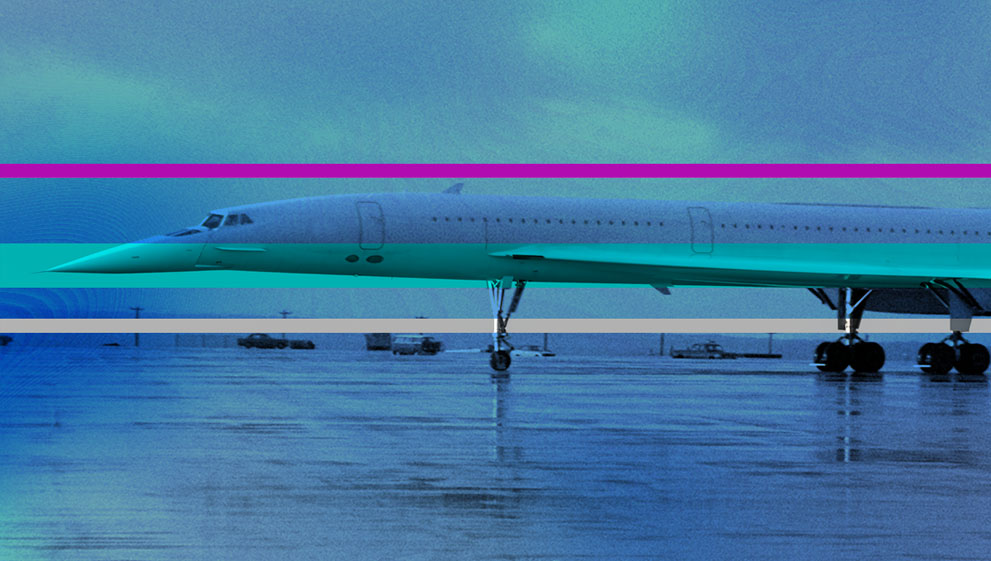
On 26th November 2003, Concorde took to the skies for the last time. The British Airways aircraft, registered G-BOAF, flew from Heathrow to Filton in Bristol, where it had been built. Now, 23 years later, it remains on display at Aerospace Bristol.
The result of a joint British and French engineering project, Concorde first flew in 1969 and entered commercial service in 1976. Only 20 aircraft were ever built. Travelling at around 1,320mph and at an altitude of up to 60,000 feet, Concorde could cross the Atlantic in less than half the time of a conventional passenger aircraft.
One of the biggest challenges facing its designers was heat. At twice the speed of sound, the aerodynamic heating of the aircraft's surface caused temperatures at the nose to reach approximately 127°C. In fact, the heat caused Concorde to expand in length by around 20cm during supersonic flight, contracting again as it slowed down and cooled.
Although most of Concorde's airframe was constructed from a specially developed aluminium alloy known as Hiduminium RR58, stainless steel and titanium were used in areas exposed to particularly high temperatures and structural loads.
Stainless steel was used in the construction of sections of the engine housings, known as nacelles, which accommodated Concorde's four Rolls-Royce/Snecma Olympus 593 engines. Stainless steel honeycomb structures helped the engineers achieve the required strength and rigidity whilst keeping weight to a minimum.
Concorde's speed was perhaps best demonstrated on 7th February 1996, when it flew from New York to London in just 2 hours, 52 minutes and 59 seconds, averaging more than 1,250mph during the crossing.
The properties that made stainless steel so useful to Concorde's engineers also make it an ideal material for many everyday applications. Here at DSM, we manufacture bespoke stainless steel products for both commercial and domestic environments, including stainless steel worktops, sinks and extractor canopies. Each is manufactured to meet the individual requirements of our customers.
Whilst our bespoke stainless steel extractor canopies might not be capable of breaking the sound barrier, they're very good at dealing with hot air!
Image: Air France Concorde, photographed on 27th September 1977, just a year after the aircraft entered commercial service. Original photograph: PH3 Caffaro, US Navy (Public Domain). Colour added..
For more stainless steel aircraft on our website have a look at these past articles:
How stainless steel helped find Flight 781 in 1954
The worlds first stainless steel flying boat!
I Feel The Need…The Need For Speed! TopGun, the F14 and Stainless Steel…